
Segmented Dies
Tungsten Carbide Hex Bolt Die for Cold Heading
Tungsten carbide hex bolt die for cold heading lines. Jungu checks hex corner support, blank volume, shrink fit, die case stiffness, and corner crack pattern before quoting.
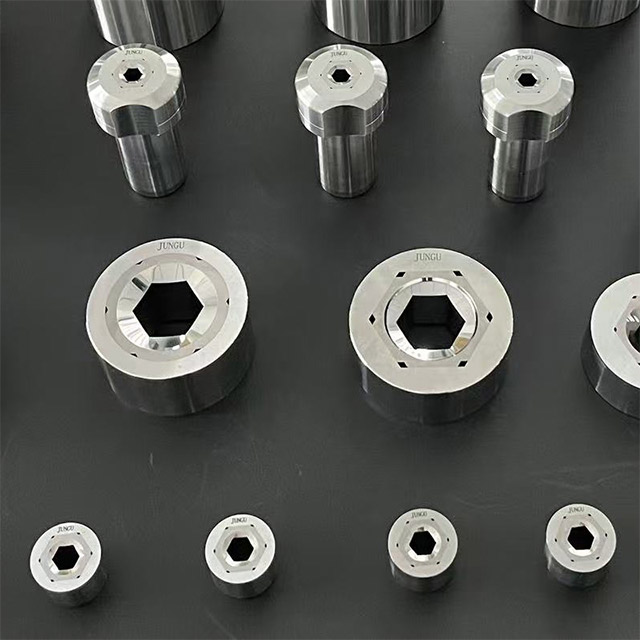
What is Tungsten Carbide Hex Bolt Die for Cold Heading used for?
A tungsten carbide hex bolt die forms the hex head or hex-related cavity under high compressive load. The weak point is usually the corner. If the blank volume is high, the corner radius is too small, or the die case does not support the carbide evenly, cracks start from the hex corner even when carbide hardness is correct. Jungu reviews the bolt drawing, across-flats size, corner radius, blank diameter, cut length, material grade, machine station, die case dimensions, shrink-fit route, and photos of corner chipping, radial cracks, sticking, or poor fill. This page is for buyers replacing hex bolt dies where corner life and head accuracy are more important than a generic die name. Asymmetrical corner cracks are checked against station alignment before carbide grade is blamed.
Common sourcing use
Custom fastener geometry, open-close die structures, and non-standard forming profiles.
Related product families
When is this a hex bolt-head die rather than a general hexagonal die?
Use this page when the tooling is tied to a bolt-head drawing and its across-flats size, head height, shank transition, blank volume, and cold-heading station. A broader hexagonal die may form other external hex profiles or fastener geometries, where cavity depth, release, and insert support follow a different drawing context.
Technical Review Scope
What Jungu checks
- Across-flats size, hex corner radius, head height, shank transition, and tolerance
- Blank diameter, cut length, material grade, hardness, lubrication, and forming load
- Carbide grade, shrink fit, die case support, insert depth, and release angle
- Failure: corner chipping, radial crack, sticking, head eccentricity, poor fill, or short life
Why no standard price is shown
Hex bolt die pricing depends on the head drawing, blank volume, corner geometry, carbide support, die-case dimensions, and shrink-fit route. Corner-life evidence is reviewed before carbide grade is treated as the answer.
Information Needed for Quotation
| Drawing | 2D drawing, 3D file, or sample photos with critical dimensions. |
|---|---|
| Production Context | Fastener type, material, machine model, station count, and annual demand. |
| Quality Target | Tolerance, surface finish, coating, target mould life, and current failure mode. |
| Commercial Context | Prototype quantity, mass-production demand, target delivery time, and destination country. |
Application and Buyer Fit
| Typical application | custom fastener geometry, open-close die structures, and non-standard forming profiles |
|---|---|
| Buyer review focus | part geometry, segment layout, carbide insert structure, forming pressure, and assembly fit |
| Quotation basis | drawing, material, tolerance, machine model, quantity, and target tool life |
| Review output | a custom die concept for non-standard fastener or metal-forming requirements |
Inquiry Process
- Send drawings and application details.
- Jungu reviews manufacturability and tooling route.
- Engineering confirms material, tolerance, and mould-life target.
- Quotation and lead time are prepared after technical confirmation.
FAQ
Why do hex die corners chip?
Corner chipping often comes from high pressure, small radius, poor support, blank oversize, or off-center load.
Can a larger corner radius help?
Sometimes, but it must still match the drawing and gauge requirement. Jungu checks radius with the finished part tolerance.
Is tungsten carbide always required?
For wear it is useful, but support and shrink fit decide whether it survives impact.
What should be checked before reusing the existing die case?
Check the bore, support shoulder, contact pattern, roundness, fretting, and previous shrink-fit condition. A worn case can overload a correct replacement insert.
Need this tooling reviewed?
Send drawings, machine model, material, and current failure photos for review.